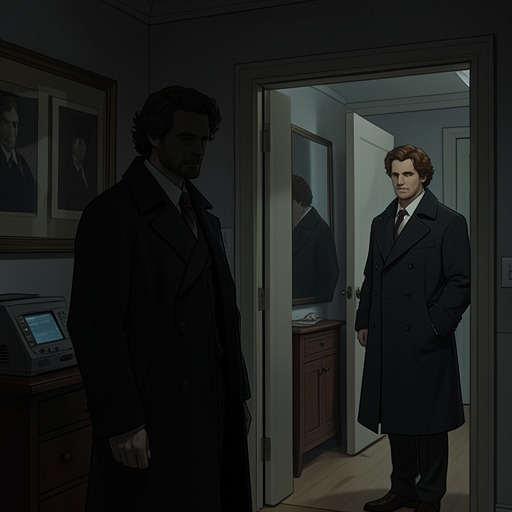
You’re not half of anything, you’re twice of everything!
The Sympathizer“You’re not half of anything, you’re twice of everything!” is The narrator's mother’s answer to the stigma of her son’s mixed heritage. First rooted in her fierce response to his childhood exclusion, the expression returns as an inner voice when he faces an uncertain opportunity, a gruesome wartime task, and the final ordeal of his imprisonment. Its insistence on being “twice” reframes the language of being “half” without erasing the injuries that made the reassurance necessary.
Origin in childhood exclusion
The expression belongs to a history of being singled out within the maternal family. At a New Year gathering, The narrator's mother’s sister withheld the red envelope he expected after respectfully wishing the adults health and happiness. A cousin later called him half-blooded and a bastard. The small, public gestures made his difference tangible: his share of lucky money was half his cousins’ sums, and the family’s judgment attached that disparity to his blood.
The narrator recalls that The narrator's mother wept with him at home and promised that he would work harder, study more, know more, and become better than the relatives who had diminished him. The remembered encouragement does not make the insult disappear; it gives him a counterstatement to carry forward. The expression’s force comes from that contrast between the family’s arithmetic of lack and a mother’s insistence that mixed heritage means not half a person but twice.
A voice at moments of choice and burden
When Violet offers him paid work as a consultant on a film being shot in the Philippines, the expression rises in his memory as he considers accepting. The job promises a break from his American refuge and a chance to save money for The crapulent major’s widow and children. His remorse over The crapulent major’s death remains persistent, and the proposed work is both an opportunity and a practical way to support those left behind. The maternal refrain accompanies him as he decides not to back away from the challenge.
The phrase returns in a harsher setting during the retreat through Laos. After the Affectless Lieutenant dies, the soldiers discover his severed leg. When the dark marine thrusts it toward the narrator, he considers refusing, then remembers his mother’s words and takes it. He brushes away the ants and carries the leg alongside his AK-47, finding the burden heavier than carrying a body. Here the expression is no simple declaration of confidence: it helps him perform an act he would rather not do, while the physical weight and the memories it summons remain present.
Repetition under interrogation
During his final examination in the reeducation camp, the narrator is strapped to a mattress, gagged, hooded, and deprived of sight and sound. As panic rises, he recalls the authorities and teachers who had defined him as a capable representative and student, then summons his mother’s assurance again. The phrase becomes part of his effort to calm himself and endure the test, even as he wonders why Man has kept him isolated and what the commissar intends.
The recurrence links experiences that differ radically in scale: childhood humiliation, a soldier’s battlefield burden, and the deliberate terror of confinement. In each, the narrator faces a test in which another person or institution has power over his body or standing. His mother’s words offer a portable rebuttal to diminishment, but the repeated need to call them up also records how often he is made to prove that he can withstand what is imposed on him.
Significance of the refrain
The expression converts the language of fraction into one of multiplication. It does not deny the narrator’s mixed identity or the discrimination attached to it; instead, it refuses the premise that mixedness makes him incomplete. Its repetition gives the narrative a thread of maternal speech that crosses family memory, wartime action, and political imprisonment, linking private injury to later tests of endurance.
The refrain’s meaning shifts with each return. In the face of family rejection, it is a promise of future achievement; in Laos, it becomes a spur to carry the dead man’s remains; in the camp, it helps the narrator hold on to a sense of self while immobilized. The words persist not as proof that he is invulnerable, but as a countervoice he can summon when others define his identity or demand that he bear more than he wishes.